Speaking at the ANS Annual Conference executive session on “How Nuclear Technologies will Shape the Future Energy Economy” were (from left) Craig Piercy, Stephen Carmel, Rian Bahran, Ross Radel, Greg Schulze, Harsh Desai, and Kirt Marlow.
The applications of nuclear energy extend beyond providing power to the electrical grid. Advanced nuclear technologies may soon have new applications in oil and gas facilities, in hospitals and clinics, on the open seas, and on the moon.
A June 1 executive session, “How Nuclear Technologies will Shape the Future Energy Economy,” at the American Nuclear Society’s Annual Conference allowed experts have an open discussion on the future of nuclear advancements in multiple sectors.
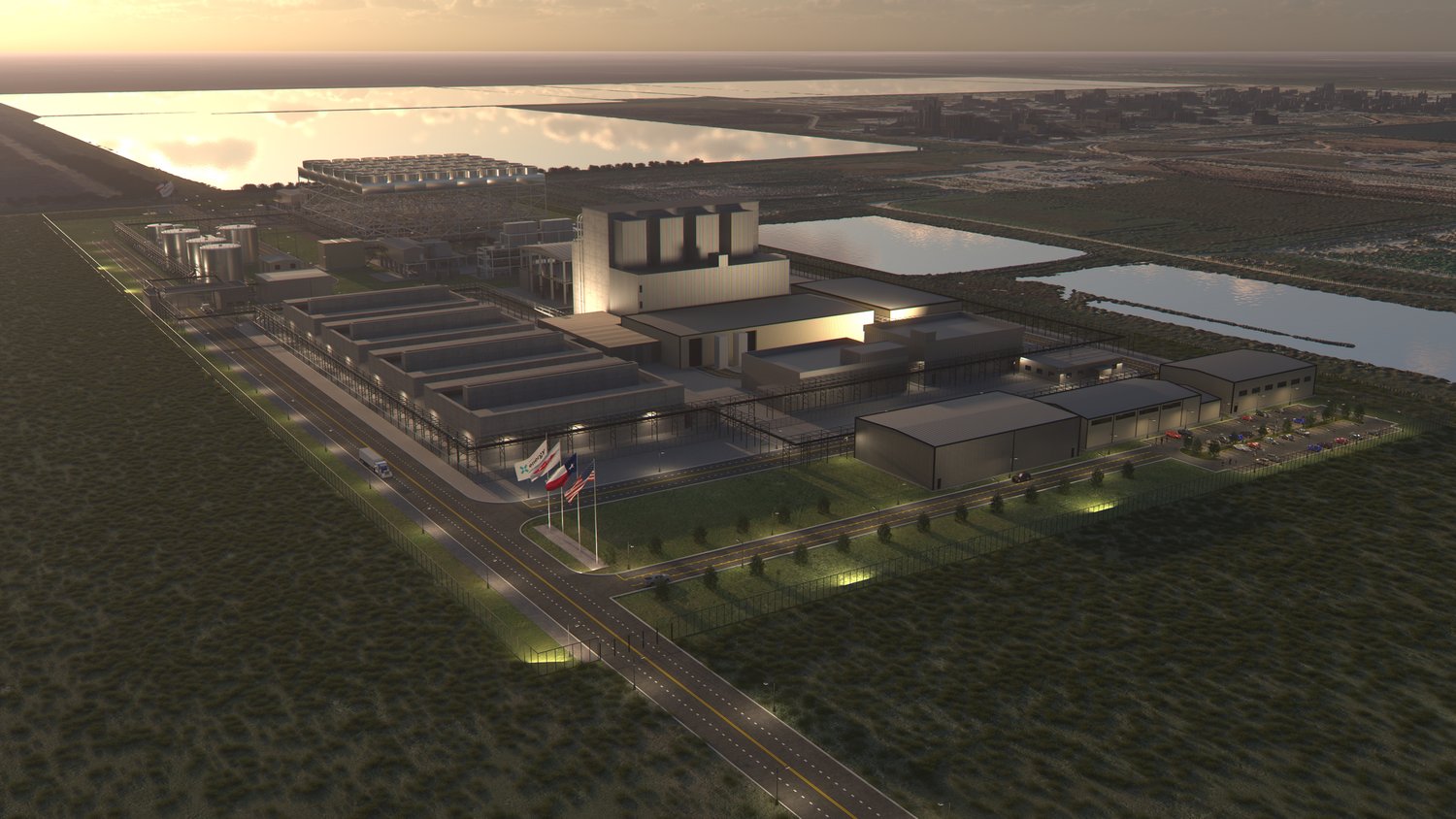
Xe-100 Dow Seadrift concept art. (Image: X-energy)
At the end of April, TerraPower announced that it had officially begun construction on its Natrium power plant in Kemmerer, Wyo.—one of the two full-scale demonstration projects in the Department of Energy’s Advanced Reactor Demonstration Program.
Now, the second ARDP-backed demonstration project, which aims to see the deployment of X-energy’s Xe-100 at a Dow chemical facility, has reached a new milestone of its own. On May 18, X-energy announced that the Nuclear Regulatory Commission has completed its environmental assessment of the proposed Long Mott Generating Facility and issued a finding of no significant impact (FONSI).
Work started on X-energy’s advanced fuel fabrication facility in Oak Ridge, Tenn., in November 2025. (Photo: X-energy)
The Nuclear Regulatory Commission has granted X-energy subsidiary TRISO-X a special nuclear material license for high-assay low-enriched uranium fuel fabrication. The license applies to TRISO-X’s first two planned commercial facilities, known as TX-1 and TX-2, for an initial 40-year period. The facilities are set to be the first new nuclear fuel fabrication plants licensed by the NRC in more than 50 years.
Annotated concept art of the Cascade Advanced Energy Facility, depicting three reactor buildings that each house four units. (Source: Amazon)
A year ago this month, Amazon led a $500 million investment in X-energy, alongside Citadel founder Ken Griffin, the University of Michigan, and other investors. In addition to that financing, Amazon pledged to support the development of an initial four-unit, 320-MW project with Energy Northwest in Washington state.
The now-closed Cottam coal-fired power station, where Holtec and EDF plan to deploy SMR-300s alongside new data centers. (Photo: Holtec)
President Trump will arrive in the United Kingdom this week for a state visit that promises to include the usual pomp and ceremony alongside the signing of a landmark new agreement on U.S.-U.K. nuclear collaboration.
Concept art of the Dow plant in Seadrift, Texas. (Source: X-energy)
The Nuclear Regulatory Commission is providing the opportunity to request a hearing on Dow Chemical Company’s application to construct a 320-MWe nuclear power plant at the company’s Seadrift site in Calhoun, Texas. Long Mott Energy, a wholly owned subsidiary of Dow Chemical, submitted its construction permit application to the NRC in March. It was accepted for review by the agency on May 12.
Xe-100 Dow Seadrift concept art. (Image: X-energy)
Dow and X-energy announced today that they have submitted a construction permit application to the Nuclear Regulatory Commission for a proposed advanced nuclear project in Seadrift, Texas. The project could begin construction later this decade, but only if Dow confirms “the ability to deliver the project while achieving its financial return targets.”
The Mickey Mouse–shaped solar array near Epcot is made of 48,000 solar panels and is operated by Duke Energy. (Photo: Duke Energy)
There is extra significance to the American Nuclear Society holding its annual meeting in Orlando, Florida, this past week. That’s because in 1967, the state of Florida passed a law allowing Disney World to build a nuclear power plant.