Concept art of the six-module CFPP at INL, terminated before construction could begin. (Image: NuScale)
The Carbon Free Power Project (CFPP) called for the deployment of six 77-MWe pressurized water reactors at Idaho National Laboratory that would provide power to INL and to Utah Associated Municipal Power Systems (UAMPS) customers in Utah and surrounding states. But UAMPS and NuScale Power mutually agreed to end the project in late 2023, ending a first-of-a-kind SMR project that was years in the making.
Total project costs, had it been completed, were estimated at $8.03 billion, with $1.36 billion coming from the Department of Energy as part of a 10-year, noncompetitive, cost-share award.
The independent spent fuel storage installation at the decommissioned Zion plant in Illinois. (Photo: EnergySolutions)
The Department of Energy’s Office of Nuclear Energy awarded more than $19 million to five U.S. companies—Alpha Nur, Curio Solutions, Flibe Energy, Oklo, and Shine Technologies—to research and develop recycling technologies for spent nuclear fuel (SNF).
According to DOE-NE, the projects will support President Trump’s goal of curtailing U.S. reliance on foreign sources of enriched uranium while reducing the volume of SNF stored across the country. Projects are to last up to three years and will require a minimum 20 percent cost share from each award recipient.
Concept illustration of a transportation cask being unloaded at a federal spent fuel storage facility. (Image: DOE)
The Department of Energy’s Office of Nuclear Energy announced the establishment of the Center for Used Fuel Research (CUFR), to be hosted at the Idaho National Laboratory and focused on spent nuclear fuel performance, canister aging, and the fostering of innovation and collaboration.
According to the DOE, the CUFR is designed to be a national and international hub for applied research that supports and maintains compliance and advances public confidence in the safe storage and transportation of both commercial and DOE-managed spent fuel.
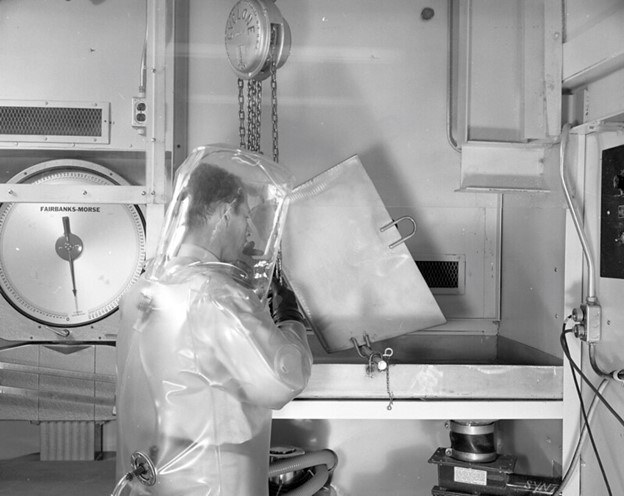
A technician prepares salts for use in MSRE in 1964. (Photo: ORNL)
FLiBe—a mixture of lithium fluoride and beryllium fluoride—is not an off-the-shelf commodity. The Department of Energy suspects that researchers and reactor developers may have a use for the 2,000 kilograms of fluoride-based salt that once ran through the secondary coolant loop of the Molten Salt Reactor Experiment (MSRE) at Oak Ridge National Laboratory.