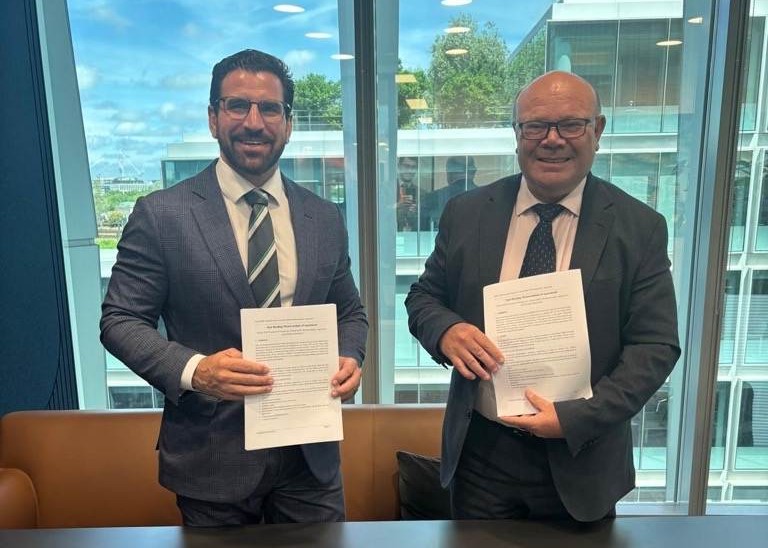
Energy Secretary Chris Wright (right) examines a fuel rod beside Deployable Energy CEO Bobby Gallagher in front of the company’s Unity microreactor. (Photo: Deployable)
Ahead of the July 4 deadline set by President Trump in Executive Order 14301, the nuclear community has been following the developments of the Department of Energy’s Reactor Pilot Program, in which companies have been pursuing DOE authorization to build and test their first-of-a-kind nuclear technologies. The EO set an ambitious goal of three reactors achieving criticality by July 4, 2026.
Concept art of a potential SMR plant at the Clinch River site in Tennessee. (Image: TVA)
Staff at the Nuclear Regulatory Commission have recommended the agency issue a construction permit to the Tennessee Valley Authority for its plans to construct a GE Vernova Hitachi Nuclear Energy (GVH) BWRX-300 reactor at the Clinch River site in Tennessee, according to the safety evaluation report published as part of the construction permit application process.
The recommendation to the commissioners is a boon for the project, which proposes constructing a 300-MWe boiling water reactor in Oak Ridge, Tenn. The June report—available in the NRC ADAMS library—presents the NRC staff’s review of TVA’s 2025 application and any additional information staff received through April of this year.
A still from a NASA video of the PROMISE rover. (Image: "NASA Moon Base Update"/NASA)
NASA has announced that it will release a solicitation related to lunar surface power this month and that it is considering sending a rover powered by a radioisotope thermoelectric generator (RTG) to the moon.
Duane Arnold nuclear power plant. (Photo: NextEra Energy Duane Arnold)
Updates from utility companies in Colorado and Arizona, nuclear legislation and discussions, and the potential Duane Arnold restart were among the news items in the month of June at the local and state levels.
PNTL’s Pacific Grebe delivers HLW to Germany. (Photo: NDA)
Completing an international commitment between the two countries, the United Kingdom’s Nuclear Transport Solutions (NTS) delivered the third and final shipment of vitrified high-level radioactive waste to Germany, the U.K. Nuclear Decommissioning Authority (NDA) announced last week.
In an ICF experiment at NIF, the lasers converge at tiny entrance holes at the top and bottom of the hohlraum. The intersection of the lasers enables crossed-beam energy transfer, an important factor in maintaining symmetry of implosions. (Image: LLNL)
New calculations by scientists at Lawrence Livermore National Laboratory suggest that changing the polarization of the National Ignition Facility’s lasers could reduce backscatter, an effect that can make an optic unusable after a single shot.
DOE Secretary Chris Wright speaks at Idaho National Laboratory on June 25. (Photo: DOE)
For just over a year, President Trump’s Executive Order 14301, “Reforming Nuclear Reactor Testing at the Department of Energy,” has loomed large because it pegged a stretch goal to a significant date: July 4, 2026. Will there be at least three participants in the Department of Energy’s Reactor Pilot Program whose reactors achieve criticality by Saturday’s deadline?
A sign along U.S. Route 20 on Idaho National Laboratory land marking the boundary of NRIC’s new Nuclear Energy Launch Pad INL. (Photo: NRIC)
In June 2025, the Department of Energy announced the Reactor Pilot Program, an authorization pathway that allowed reactor developers to partner with the DOE to get first-of-a-kind (FOAK) reactors built and tested. Soon after, the DOE rolled out a complementary Fuel Line Pilot Program, which aimed to fast-track fuel projects. In all, 20 projects were accepted into the new programs.
Unless otherwise noted, all photos are courtesy of Idaho National Laboratory.
In 2019, a familiar landmark at Idaho National Laboratory was scheduled for demolition. Though striking for both its physical presence and its significance to nuclear history, the containment dome that once housed Experimental Breeder Reactor-II sat unused—that is, until INL realized its potential as a reactor testing facility.
The Hanford 222-S building. (Photo: DOE)
The Department of Energy’s Office of Environmental Management issued a draft request for proposals on June 25 for the Hanford Site’s 222-S Laboratory contract. The 222-S Laboratory is the primary on-site laboratory for analysis of highly radioactive samples in support of all projects at the DOE’s Hanford Site in Washington state.
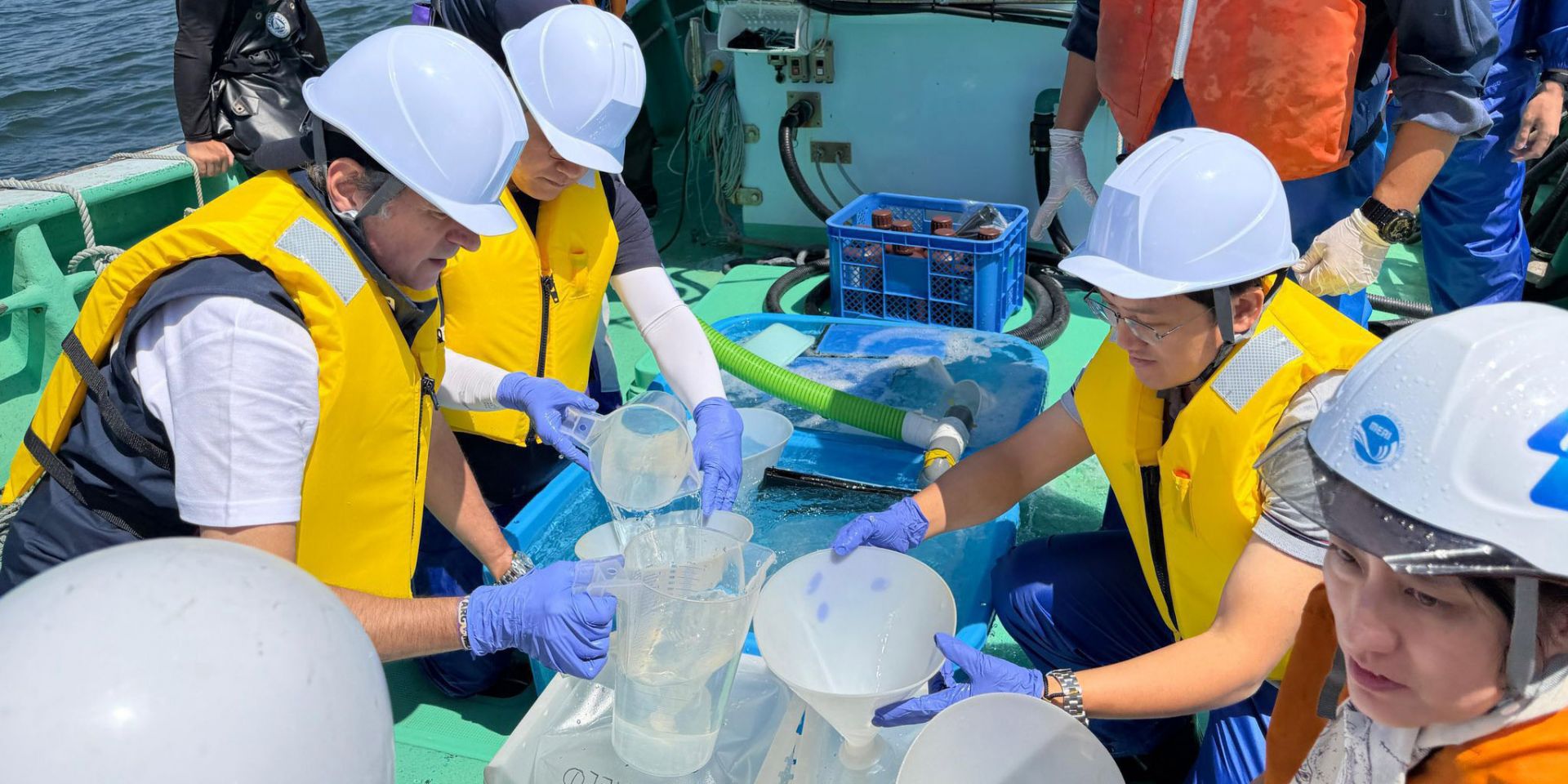
IAEA director general Rafael Mariano Grossi took part in a collection of seawater samples near the Fukushima Daiichi Nuclear Power Station on June 24 with scientists from China, South Korea, and Switzerland. (Photo: K. Laffan/IAEA)
International cooperation in the monitoring of radiation levels in seawater near the disabled Fukushima Daiichi nuclear power plant continues. Scientists from China, South Korea, and Switzerland were recently joined by International Atomic Energy Agency director general Rafael Mariano Grossi as they collected seawater samples under the “additional measures” framework, which was adapted in 2024 to increase the participation of other countries and enhance the transparency of the IAEA-led analyses.
An aerial view of the 10 facilities of Isotope Row, located in the heart of ORNL. (Photo: DOE)
Having completed deactivation work, the Oak Ridge Office of Environmental Management (OREM) is set to begin demolition in July of a cluster of highly contaminated buildings at Oak Ridge National Laboratory in Tennessee, the Department of Energy’s Office of Environmental Management announced this week.